Catalan leader Carles Puigdemont is facing growing pressure to drop plans to break from Spain ahead of a key address to the regional parliament.
There is speculation he may announce a unilateral declaration of independence following a disputed referendum.
Catalan police have been posted outside parliament in Barcelona, sealing off the grounds to the public.
The mayor of Barcelona has urged Mr Puigdemont and Spanish PM Mariano Rajoy to "de-escalate" the crisis.
Mr Puigdemont's address, which is due at 18:00 (16:00 GMT), comes after a vote was held on 1 October which Catalan officials say resulted in almost 90% of voters backing independence. Turnout was put at 43%.
The vote was deemed illegal by Madrid and suspended by Spain's Constitutional Court. "No" voters largely boycotted the ballot and there were several reports of irregularities. National police were involved in violent scenes as they manhandled voters.
Tom Burridge, BBC News, Barcelona
Never before has the world watched Catalonia's regional parliament so closely. This evening, with probably large numbers of police and protesters outside, the leader of the devolved government is due to address Catalan MPs. Carles Puigdemont plans to present his government's results of the disputed referendum, which Madrid declared illegal.
Since then, Mr Puigdemont has said on several occasions that he will declare independence, despite fierce opposition across Spain and criticism from European governments.
Now, will he make good his threat? Or will he announce a more nuanced strategy, hoping still for a proper, recognised referendum one day? Under pressure to act, the Spanish government has made stark warnings, too. If the order comes, thousands of Spanish national police, here in Barcelona, could intervene.

What security measures are being taken?
The Catalan police force, the Mossos d'Esquadra, closed the Ciutadella Park, where parliament is located, early in the day, positioning vans near the entrances and alongside parliament.
The authorities said the measures were "for safety reasons".
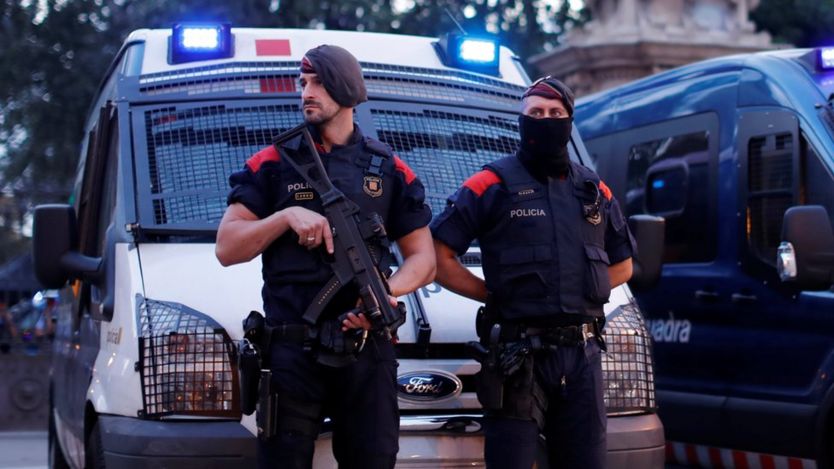 Image copyrightREUTERSImage captionArmed police have been deployed outside parliament copyrightANCImage captionThe ANC has been calling on supporters to come to the parliament
The Catalan National Assembly (ANC), a non-party grassroots movement, earlier urged supporters in a tweet to come to the parliament district to "defend" the vote for independence
What is Puigdemont likely to tell parliament?
Independence supporters have been sharing the Catalan hashtag #10ODeclaració (10 October Declaration) on Twitter.
Expectations are high that Mr Puigdemont will ask parliament to declare independence on the basis of the referendum law it passed last month.
Parliament, which is dominated by pro-independence parties, would then have 48 hours to vote.
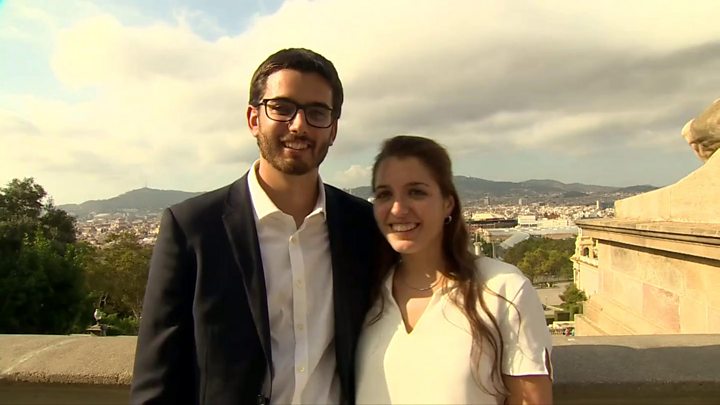
Media captionPablo Insa Iglesias and Elisabeth Besó sit on opposite sides of the argument
Barcelona's influential mayor, Ada Colau, has urged Mr Puigdemont not to declare independence. She also called on Mr Rajoy to rule out direct control from Madrid.
When the BBC asked people for their opinion in Barcelona, one woman, Eva Iniesta, called for the Spanish government to open a "dialogue so independence is not declared".
But another person, Salvador Puig, said: "We have demonstrated and said that we don't like being part of this home and we have the right to live in the home we want and in the way we want."
How is Madrid likely to react?
Mr Rajoy is due to appear in Spain's parliament on Wednesday. He has already said any declaration of independence by Catalonia would "lead to nothing".
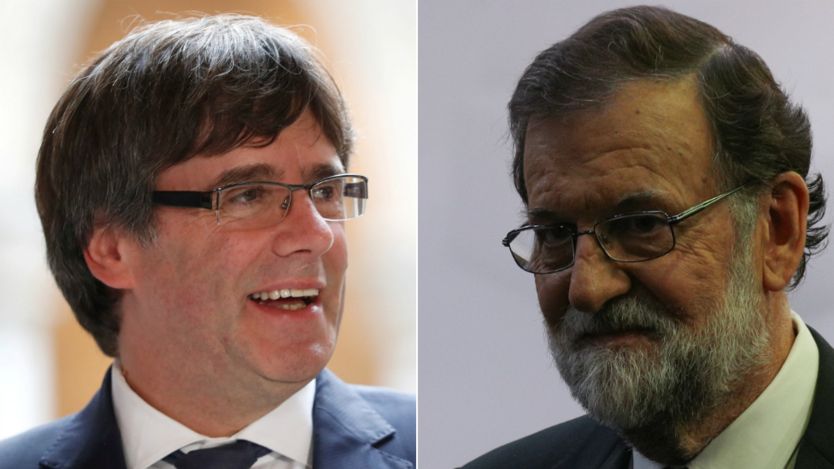 Image copyrightREUTERSImage captionCarles Puigdemont, left, and Mariano Rajoy show no signs of compromise
Under Article 155 of the constitution, his Spanish government could suspend devolution.
The leader of Spain's main opposition party, Pedro Sánchez of the Socialists, has said his party will back action by the government "in the face of any attempt to break social harmony".
What pressure is big business exerting?
A stream of companies have announced plans to move their head offices out of Catalonia in response to the crisis.
It is one of Spain's wealthiest regions, accounting for a quarter of the country's exports.
Publishing company Grupo Planeta is the latest to announce it will move from Barcelona to Madrid if there is a declaration of independence.
Do the separatists have support internationally?
The European Union has made clear that should Catalonia split from Spain, the region would cease to be part of the EU.
A European Commission spokesman told Reuters news agency it called on "all those concerned to get of this confrontation as quickly as possible and to start dialogue".
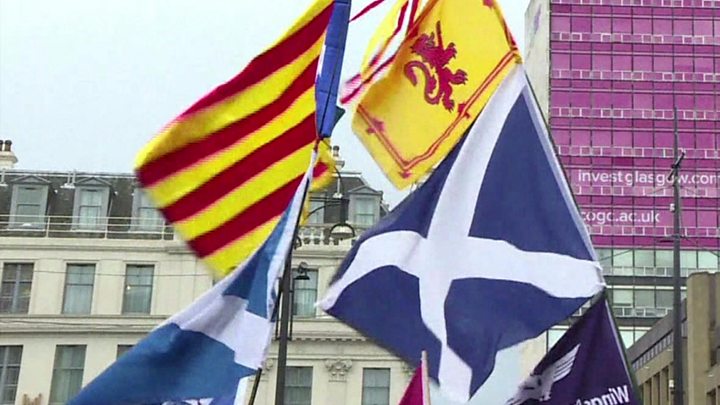
Media captionWhat do Scottish nationalists think about Catalonia?
The EU, he added, had confidence "in the capacity of Prime Minister Rajoy to manage this delicate process in full respect of the Spanish constitution and the basic fundamental rights of the citizens".
Austrian Finance Minister Hans Jörg Schelling warned the effects of Catalan independence could spread beyond Spain.
"I hope that this won't lead to a crisis in the euro and in the EU but the danger naturally exists because extreme positions are clashing," he said.
How did we reach this crisis?
Catalonia, a part of the Spanish state for centuries but with its own distinct language and culture, enjoys broad autonomy under the Spanish constitution.
However, a 2005 amendment redefining the region as a "nation", boosting the status of the Catalan language and increasing local control over taxes and the judiciary was reversed by the Constitutional Court in 2010.
The economic crisis further fuelled discontent and pro-independence parties took power in the region in the 2015 elections.
Attempts to hold a legal Scottish-style referendum on independence have got nowhere with the Spanish government.


0 Comments